THE AI SALES OUTCOME GAP 2026 15 SEPTEMBER 2026
RESEARCH SNAPSHOT 7 SEPTEMBER 2026
The AI Sales Outcome Gap 2026
AI sales has a learning problem.
A public-claims audit of 100 AI sales and revenue products. On the public pages reviewed, 69 of 100 products made sales execution a strongly evidenced core capability. Only eight did the same for learning from downstream commercial outcomes.
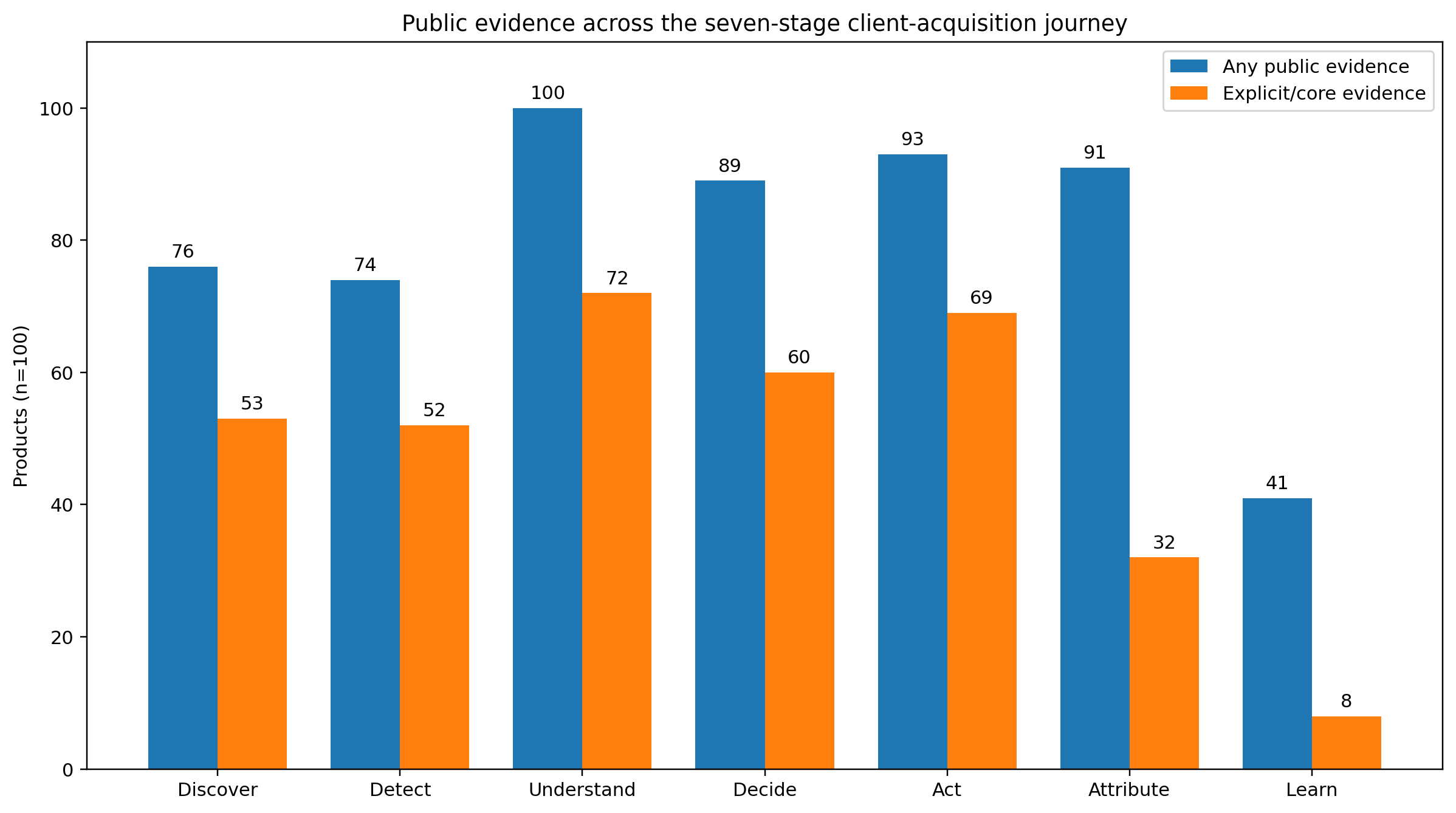
69 strongly evidenced Act. 32 strongly evidenced Attribute. 8 strongly evidenced Learn.
Purposive, non-random sample of 100. Public-claims audit. Go7 was excluded from scoring.
This is not hands-on product testing. “No public evidence located” does not mean a capability is absent.
Research note and disclosure
This report evaluates what 100 products publicly claim, describe and evidence on the pages reviewed. It is not hands-on product testing, a vendor ranking or a declaration that undocumented capabilities do not exist.
Commissioned and authored by Go7. Go7 is developing a platform in the same broad category and therefore has a commercial interest in the market. To reduce that conflict, Go7 was excluded from scoring.
AI sales is scaling activity faster than learning.
Products are generally much more explicit about the work they can execute than the commercial outcomes they can learn from. The audit examined seven stages: Discover, Detect, Understand, Decide, Act, Attribute and Learn.
Across the 100 products, 69 strongly evidenced Act, 32 strongly evidenced Attribute and only 8 strongly evidenced Learn.
Read this carefully. These findings describe evidence located in public material. Not finding a capability does not prove that a product lacks it.
Execution is ahead of outcome learning.
The public story is fluent in activity. It is much quieter on what happens after the meeting, reply or opportunity.
Sales work is easy to show. Learning is not.
69 products clearly presented automation of sales work. Only eight clearly showed how commercial results change future decisions.
Activity is sometimes linked to commercial results.
32 products clearly linked activity to pipeline, wins, forecasts or revenue. That is useful context, but it is not the same as learning.
The market still leads with proxies for success.
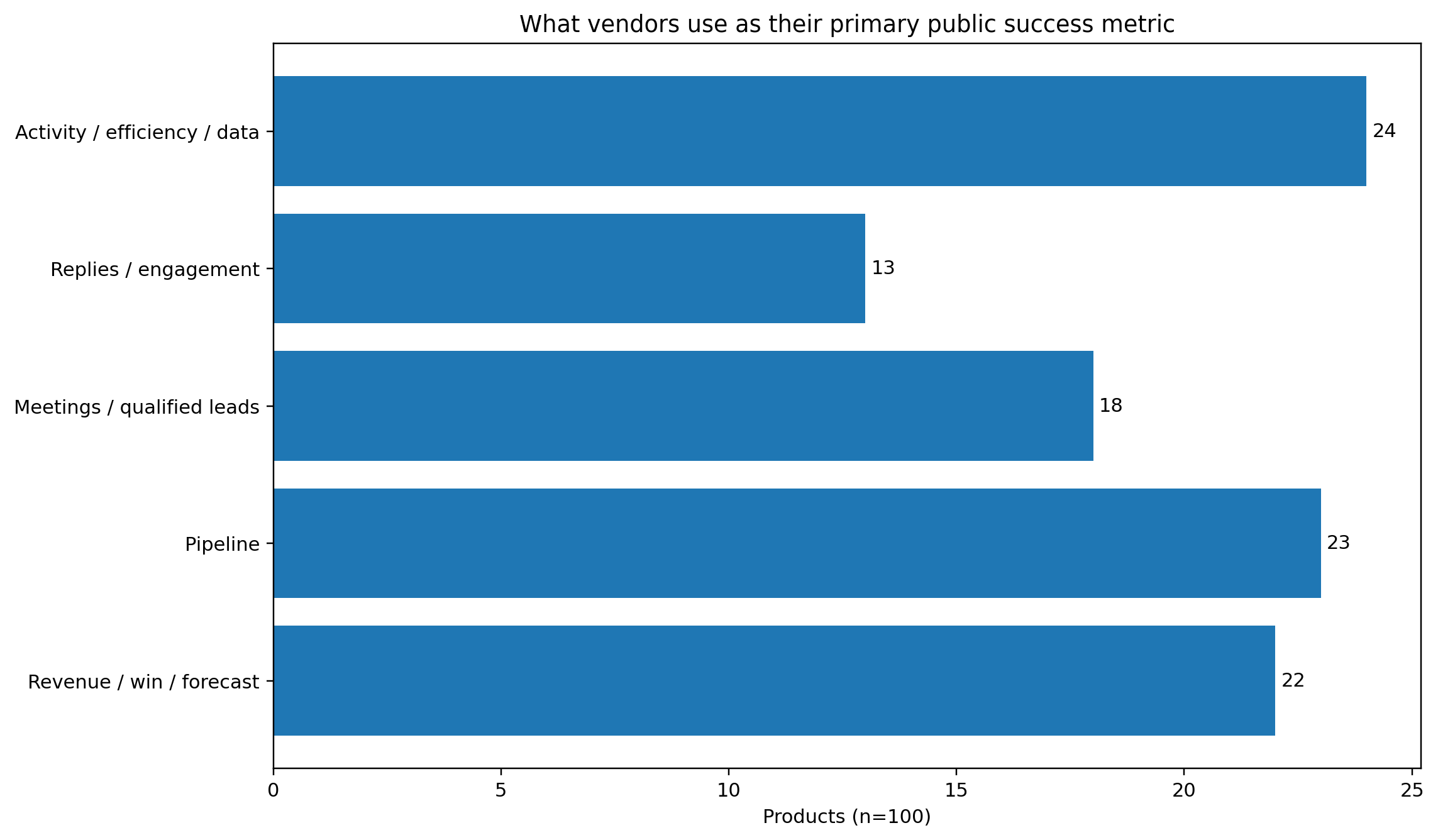
55 products primarily promoted activity, efficiency, data, replies or meetings. 23 led with pipeline, and 22 with revenue, win rate or forecasting outcomes.
Human approval controls were not clearly visible.
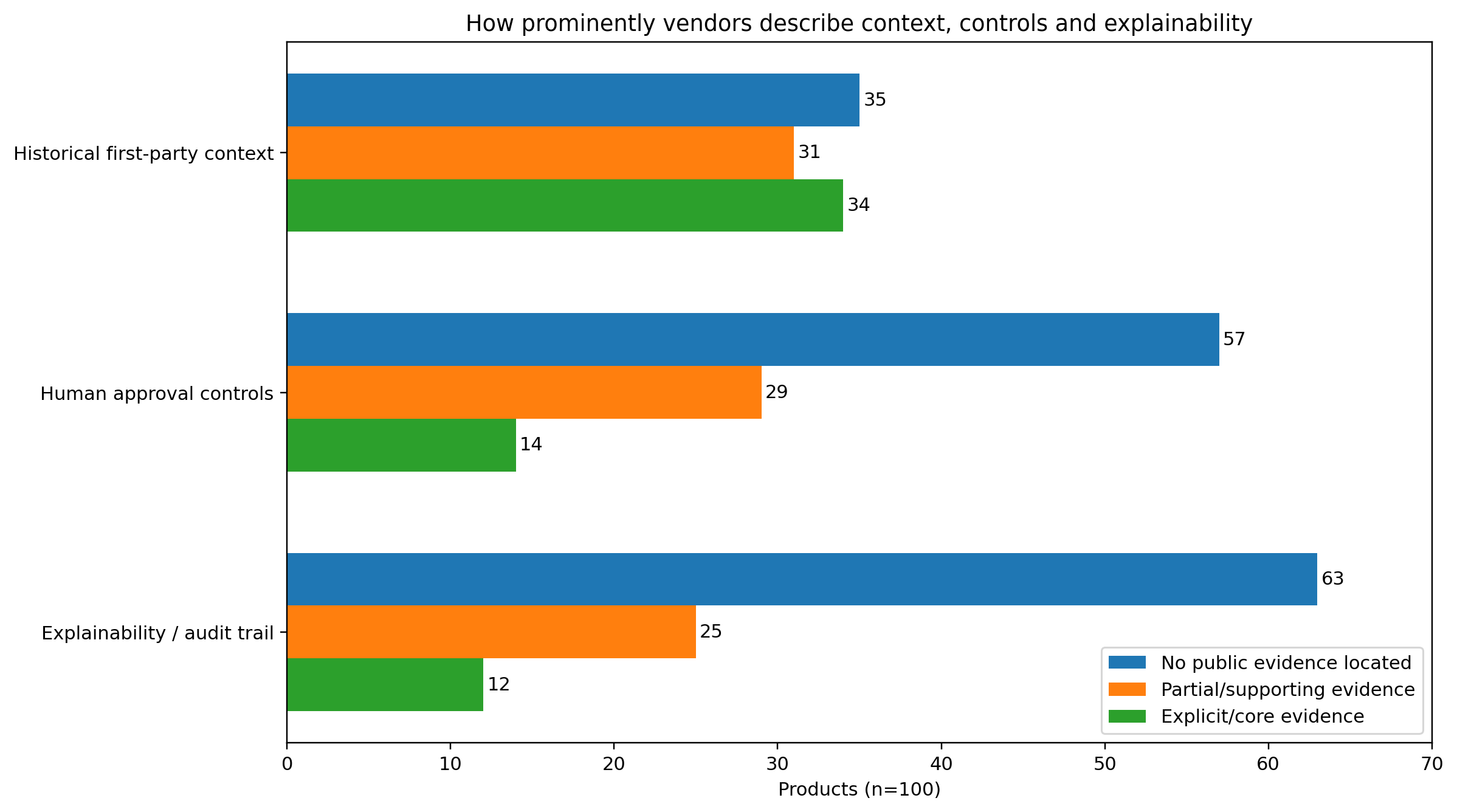
57 products did not clearly show human approval controls in the public material reviewed. This does not mean the functionality is absent.
Explainability and audit trails were harder to find.
63 products did not clearly show explainability or audit trails on the public pages reviewed. The finding describes visibility, not product absence.
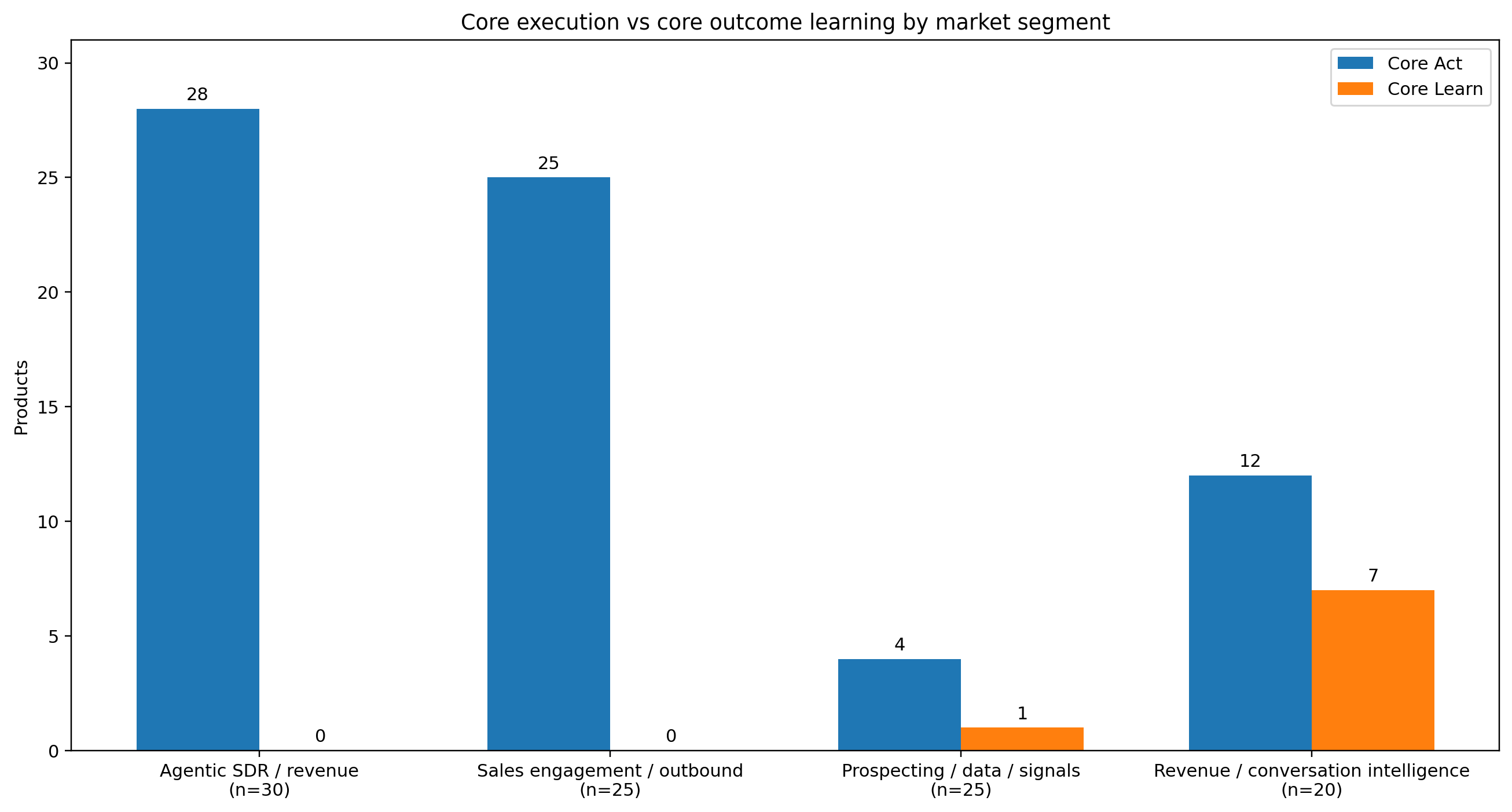
The gap was widest in outbound sales.
Outbound software is increasingly capable of finding prospects, generating messages, running sequences and following up automatically.
What was far less visible was the final step: did the prospect become a genuine opportunity? Did the deal close? Why? And does that result change what the system does next?
THESIS
04 / MARKET INTERPRETATION
The market is split between execution and intelligence.
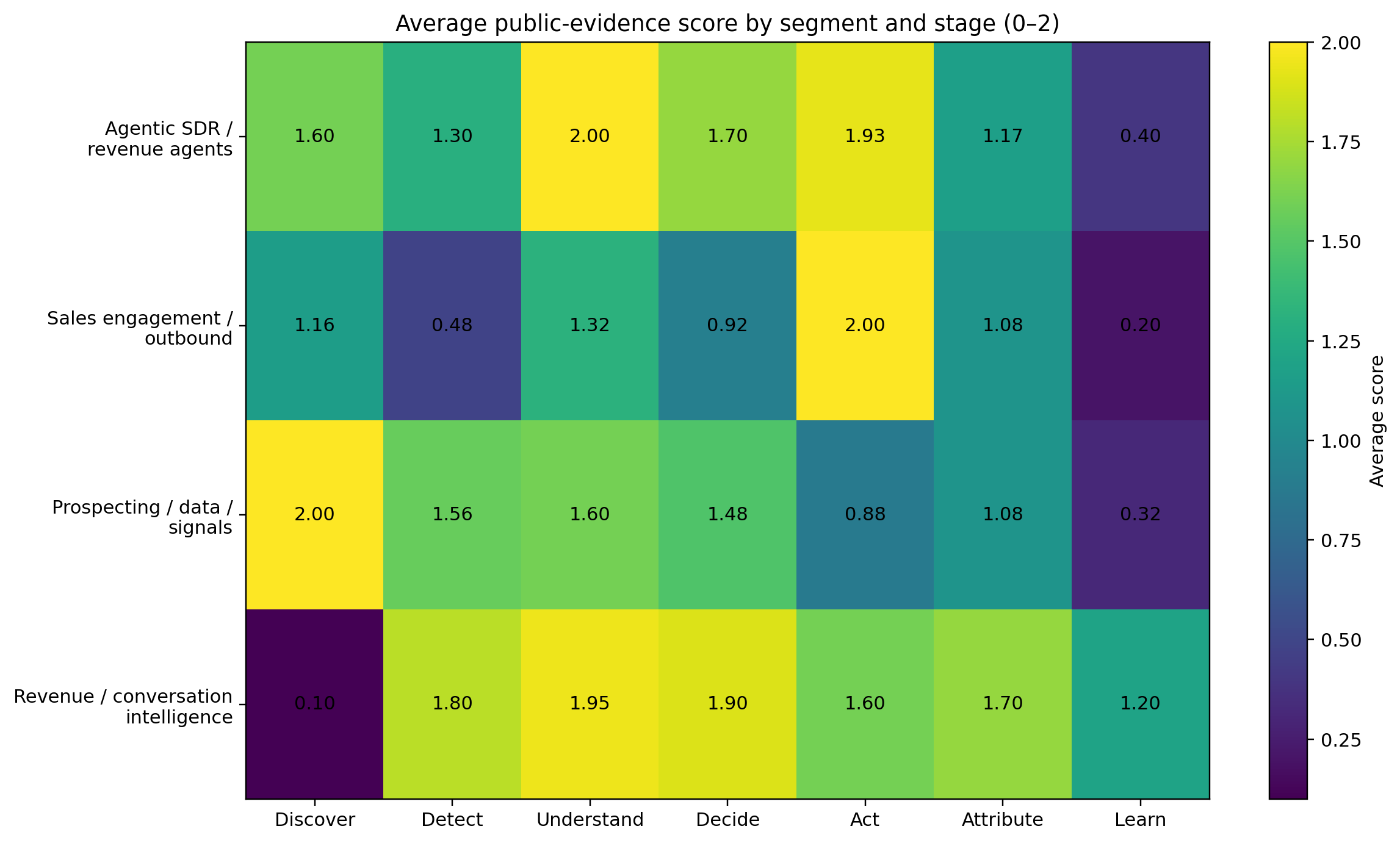
Agentic SDR products are strongest at action; revenue-intelligence products are stronger at attribution and learning but rarely discover new accounts. Upstream tools create activity. Downstream tools analyse conversations, pipeline, forecasts and revenue.
The missing layer is the connection between the two: what happened, why it happened, and what should change next?
Go7’s interpretation of the audit.The market still leads with proxy metrics.
55 products used activity, efficiency, replies or meetings as the primary headline metric. Twenty-three led with pipeline; 22 led with revenue, win rate or forecast outcomes.
This does not mean activity or meeting metrics are unimportant. They are immediate and measurable. The risk is that they become the objective rather than a diagnostic step on the route to qualified opportunity and revenue.
Controls and explainability are not prominent.
57 products had no public evidence of human approval controls in the reviewed pages, and 63 had no public evidence of explainability or audit trails. These figures measure public visibility, not whether private or in-product functionality exists.
- Why did the system make that decision?
- What can it do without approval?
- Can a human intervene?
- Can its decisions be reviewed afterwards?
Adoption is not the same as proving value.
AI agents are moving rapidly from demonstrations into sales workflows. Gartner predicts that agents could outnumber human sellers ten to one by 2028, while fewer than 40% of sellers may say those agents improved productivity. Gartner’s warning is that fragmented systems can simply lead agents to scale the fragmentation.[1]
The governance gap is also visible beyond sales. Gartner reported in April 2026 that only 13% of organisations believed they had the right AI-agent governance in place.[2]
McKinsey’s 2026 B2B sales research argues that value comes from embedding agentic AI into end-to-end commercial workflows rather than layering isolated tools onto existing processes.[3] Salesforce says nine in ten sales teams use agents or expect to within two years.[4] HubSpot has shifted parts of its agent pricing towards completed outcomes rather than output volume.[5]
Built to be checked, challenged and corrected.
The accompanying workbook contains product-level scores, stage-level evidence, coding notes, reviewed URLs and research dates behind the material findings.
Evidence note. “No public evidence was located in the pages reviewed” is not the same as evidence that a feature is absent. The charts describe public claims, not product performance.
How we did the research.
The research reviewed a purposive, non-random sample of 100 active, publicly marketed English-language products across four segments: Agentic SDR and revenue agents (30); Sales engagement and outbound execution (25); Prospecting, data and signal intelligence (25); and Revenue and conversation intelligence (20). The sample is structured but not random and must not be described as representative of every AI sales product worldwide.
Products were identified through official vendor pages, public category searches, pricing pages, help centres, product documentation, case-study libraries and current market roundups. Official product, pricing, documentation and case-study pages were preferred. Third-party sources were used only where official pages were inaccessible or where a current product rename or public pricing reference required verification. Source URLs and review dates appear in the master workbook.
This is a public-claims audit, not hands-on product testing. Researchers did not log into every platform or independently test performance.
Stage scoring
Each of seven stages was scored 0, 1 or 2. The stage definitions are practical coding categories, not a universal product taxonomy.
- 0 — No public evidence located
- In the pages reviewed. This is not evidence that the feature is absent.
- 1 — Partial or supporting evidence
- The capability assists the stage but is not clearly positioned as a core product capability.
- 2 — Explicit/core evidence
- The capability is clearly described, documented or positioned as central to the product.
Discover — Market/account identification, list building or contact discovery.
Detect — Buying signals, timing, intent, behavioural or trigger detection.
Understand — Account research, CRM/history use, conversation context or account intelligence.
Decide — Prioritisation, scoring, routing, next-best action, strategy or explainable recommendation.
Act — Autonomous or workflow execution across email, calls, CRM actions, routing or other sales tasks.
Attribute — Connection to qualified opportunities, pipeline, forecast, win rate or revenue.
Learn — Use of downstream replies, opportunities, wins, losses or revenue to improve future decisions or agent behaviour.
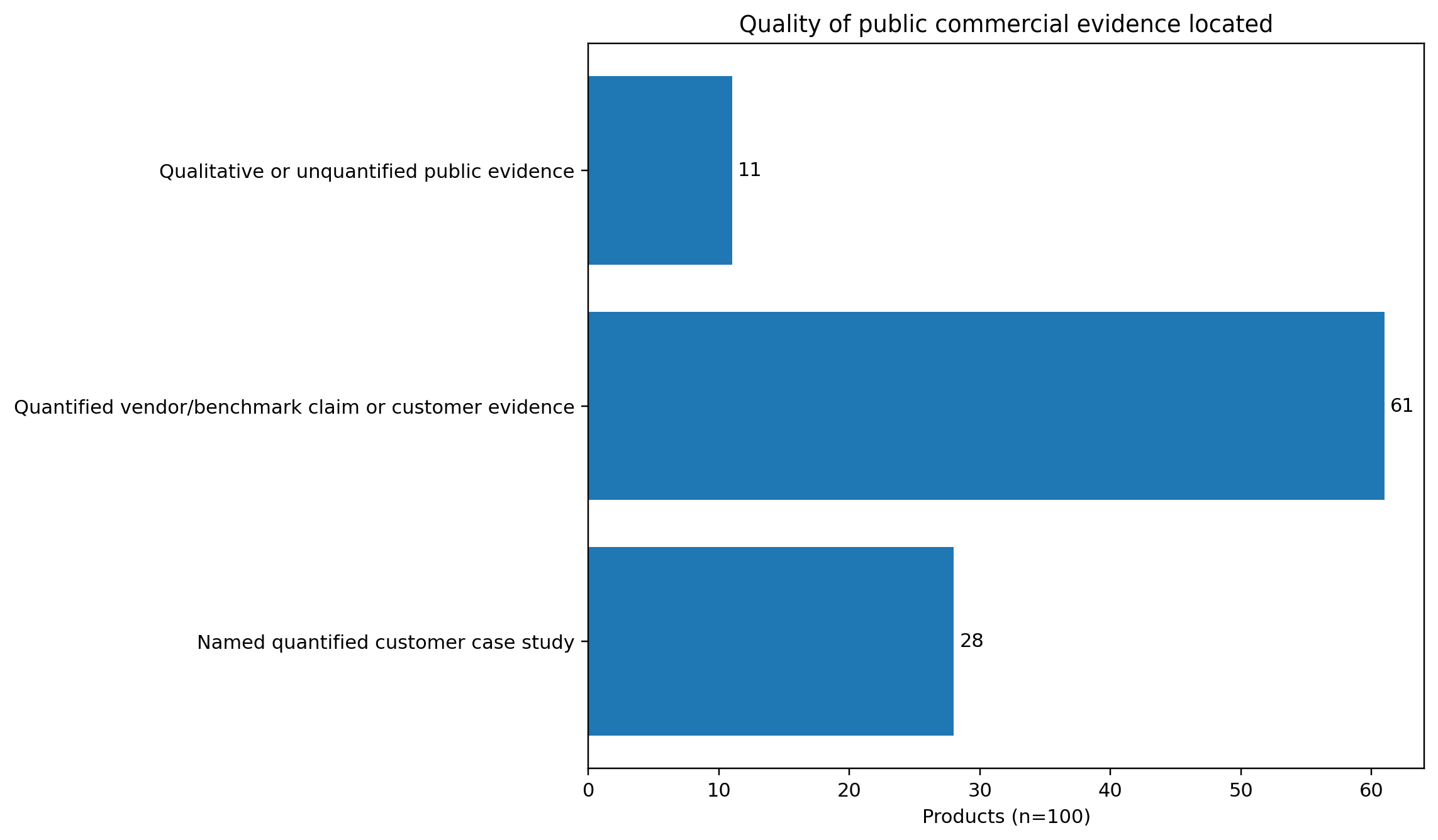
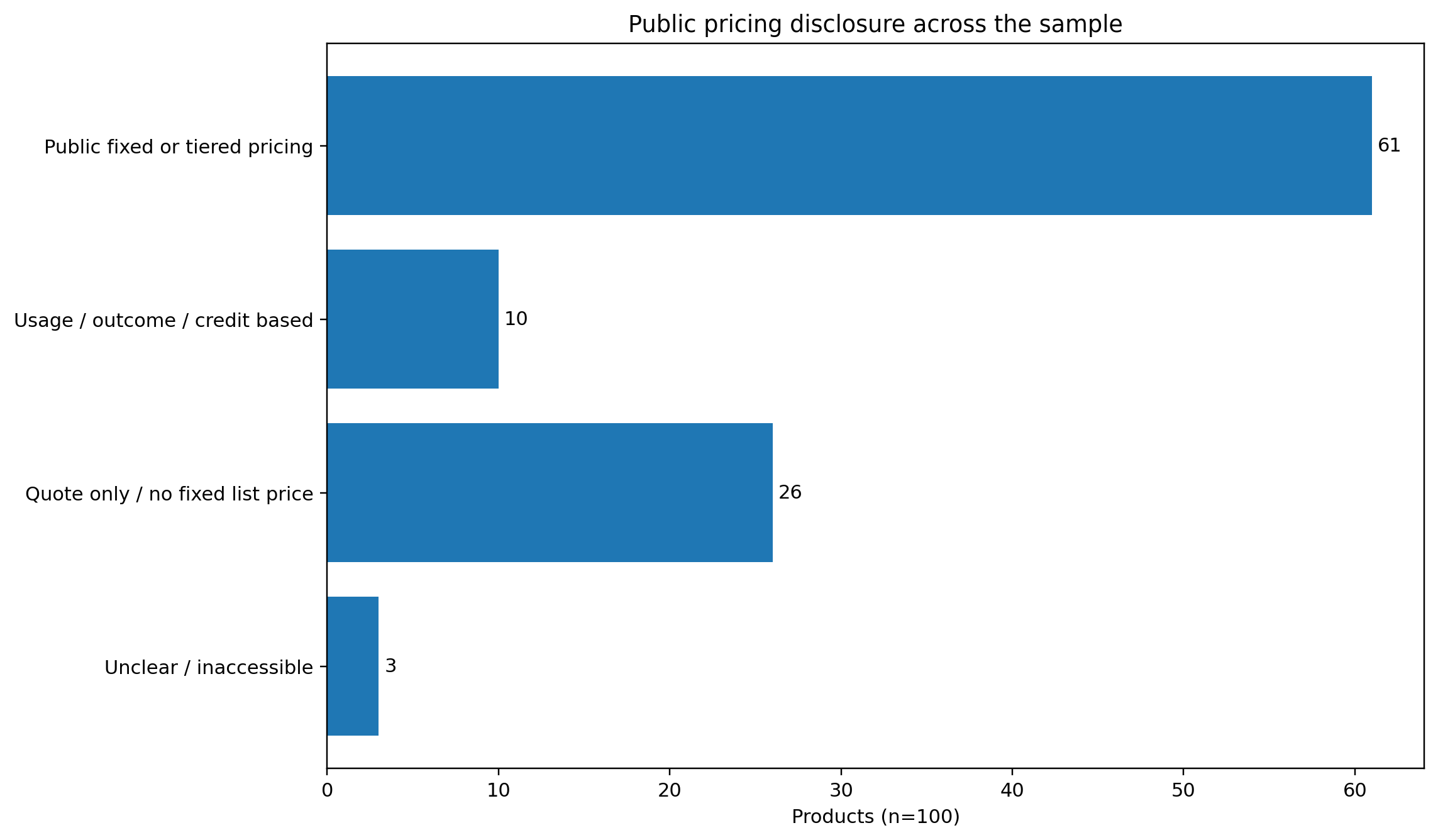
The audit also coded historical first-party context, human approval controls, explainability/audit trails, public pricing, public case studies and the primary metric used in headline positioning. Commercial evidence was graded from qualitative/unquantified evidence through named quantified customer cases.
Corrections: Please include the product name, field or stage being challenged, the proposed correction and a public source URL. Accepted corrections will be logged with the old value, new value, evidence and date.
Limitations, risk controls and corrections.
- Public-claims audit
- The research evaluates public evidence, not all product capability.
- No product testing
- Researchers did not log into every platform or independently test performance.
- Non-random sample
- The 100 products form a structured sample, not a census or statistically representative market sample.
- Dynamic market
- Product pages, names, prices and functionality can change quickly.
- Evidence interpretation
- A score reflects how explicit a capability was in reviewed material, not whether one product is better than another.
- Commercial conflict
- Go7 operates in the category. The commissioner disclosure, exclusion of Go7 and source-backed coding should appear in every release.
- Vendor corrections
- Vendors should be invited to submit source-backed corrections. Changes must be logged rather than silently overwritten.
Safe language
- Use: “No public evidence was located in the pages reviewed.” Avoid: “The product cannot do this.”
- Use: “Eight products strongly evidenced outcome learning.” Avoid: “Only eight products can learn.”
- Use: “In this structured sample of 100 products...” Avoid: “The AI sales market as a whole...”
- Use: “Vendor-published named customer case.” Avoid: “Independently proven result.”
Use the source.
Go7. "The AI Sales Outcome Gap 2026." 2026.
- Commissioner and author
- Go7
- Publication date
- 15 September 2026
- Research snapshot
- 7 September 2026
- Canonical URL
- https://go7.ai/research/ai-sales-outcome-gap-2026
12 / FOR JOURNALISTS
Report the finding with its context.
In a review of 100 publicly marketed AI sales and revenue products, 69 strongly evidenced Act, 32 strongly evidenced Attribute and eight strongly evidenced Learn.
Media enquiries and corrections
contact@go7.ai
Charts and findings may be reproduced with attribution to Go7 and a link to this research.
13 / ABOUT THE COMMISSIONER
Commissioned and authored by Go7.
The original report describes Go7 as a company developing a platform in the same broad category and states that it has a commercial interest in the market. Go7 was excluded from scoring. This is the historical commissioner disclosure, not an independent assessment.